Losses on First Resale of New Builds
2026-05-12
The “new-build premium” has long been a familiar feature of the UK housing market. Buyers are often willing to pay more for a pristine property that has never been lived in, benefiting from modern layouts, energy efficiency, developer incentives and low maintenance costs.
However, analysis of 31 years of Land Registry transaction data suggests that this premium can evaporate surprisingly quickly — especially for flats.
Our analysis focuses only on properties that were originally sold as brand-new homes and later resold on the open market. It is important to note that Land Registry data does not capture off-plan purchases, which means some early investor activity is not reflected in these figures.
The 10-Year Resale Picture
The first chart examines properties resold in a given year that had originally been purchased as new builds within the previous 10 years.
For example, in 2025:
- 42.4% of flats originally bought as new builds between 2015 and 2024 were resold for less than their original purchase price.
- For houses, the figure was only 7.7%.
This illustrates a striking divergence between flats and houses in the modern UK housing market.

What Happens Over a Shorter 5-Year Period?
The second dataset measures the percentage of properties resold at a loss when sold within five years of being purchased as a new build. The numbers reveal just how vulnerable recently built flats can be to short-term price declines.
In 2025:
- 41.2% of flats resold within five years lost money.
- The figure for houses was 14.0%.
Again, flats significantly underperform houses.

From Financial Crisis to Cladding Crisis
The data also highlights two distinct periods in the UK property market.
Between 2005 and 2008, losses on new-build flats rose sharply and were consistently higher than for houses. This largely reflected the boom-and-bust cycle surrounding the global financial crisis. In the years that followed, losses for houses and flats gradually converged.
However, from around 2018 onwards, flats began diverging from houses once again.
The likely driver was the cladding crisis, which severely affected confidence and mortgage availability for many apartment blocks across the UK. Owners of affected flats often struggled to sell, faced remediation uncertainty, or had to accept significant discounts.
The result is clear in the data:
- Loss rates for houses fell sharply after 2020.
- Loss rates for flats moved in the opposite direction.
What the Data Suggests
The findings challenge the assumption that buying a new-build property is automatically a safe financial decision. For flats in particular, there appears to be a meaningful risk of negative resale performance if the property needs to be sold within the first decade — and especially within the first five years.
Houses tell a very different story. While losses do occur, the probability is substantially lower and has improved significantly in recent years. In simple terms:
- Buying a new-build flat can carry a relatively high risk of losing money if circumstances force an early sale.
- New-build houses appear considerably more resilient.
The “new-build premium” may still exist at the point of purchase, but for many buyers — especially flat owners — it can disappear far faster than expected.
Next:
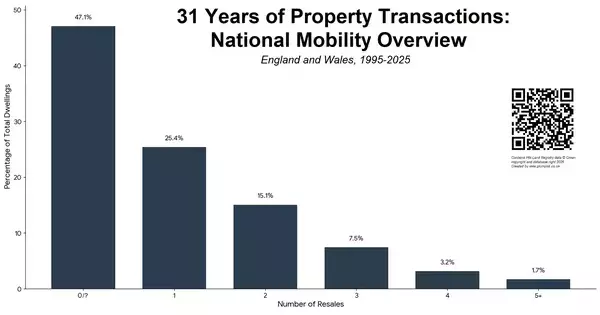
- Home Resales Analysis: England and Wales (1995-2025)
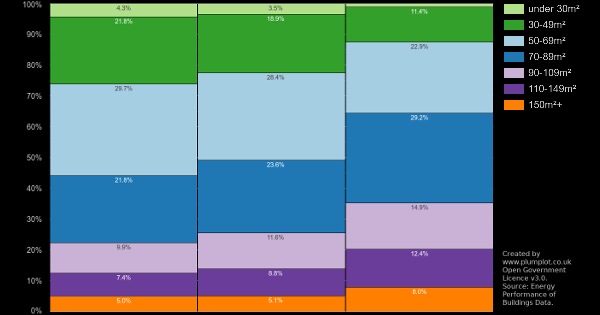
- London property sizes
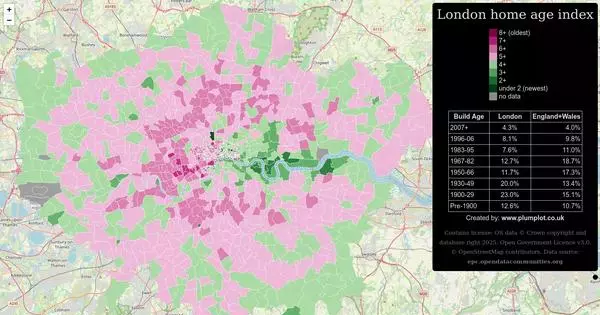
- London Building Construction Age
Contains public sector information licensed under the Open Government Licence v3.0.. Datasource: Contains HM Land Registry data © Crown copyright and database right 2026. This data is licensed under the Open Government Licence v3.0 .