| Population Estimates, 2024 | Doncaster postcode area | England + Wales |
|---|---|---|
| Total residents | 779k | 1.3% of Eng+Wls |
| Average age | 42.4 | 40.8 |
| Population density | 291 | 409 |
shows a number of residents per square kilometer(km2), estimates from 2020.

Population average age by LSOA (County) in 2018.

Total population per year outlines headcount differences.
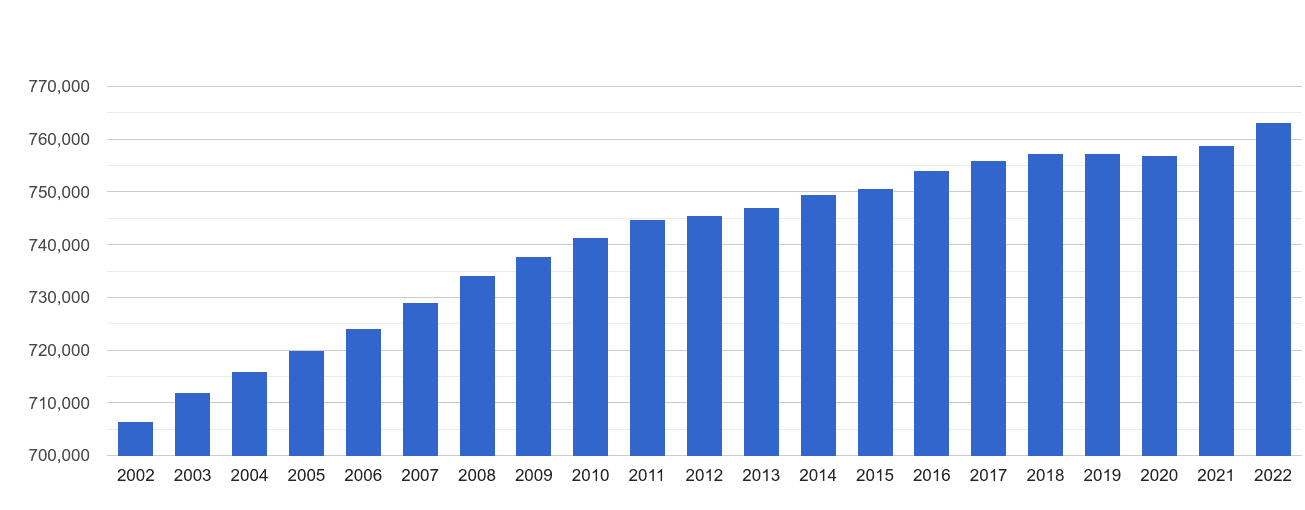
| Year | Total population | CAGR | CAGR ENG+WLS |
|---|---|---|---|
| 2024 | 779k | 0.45% | 0.74% |
| 2023 | 771k | 0.42% | 0.72% |
| 2022 | 764k | 0.39% | 0.68% |
| 2021 | 759k | 0.38% | 0.66% |
| 2020 | 757k | 0.38% | 0.68% |
| 2019 | 757k | 0.41% | 0.71% |
| 2018 | 757k | 0.44% | 0.72% |
| 2017 | 756k | 0.45% | 0.73% |
| 2016 | 754k | 0.47% | 0.75% |
| 2015 | 751k | 0.47% | 0.74% |
| 2014 | 750k | 0.49% | 0.74% |
| 2013 | 747k | 0.51% | 0.73% |
| 2012 | 746k | 0.54% | 0.73% |
| 2011 | 745k | 0.59% | 0.73% |
| 2010 | 741k | 0.60% | 0.72% |
| 2009 | 738k | 0.62% | 0.70% |
| 2008 | 734k | 0.64% | 0.70% |
| 2007 | 729k | 0.63% | 0.67% |
| 2006 | 724k | 0.62% | 0.63% |
| 2005 | 720k | 0.63% | 0.61% |
| 2004 | 716k | 0.67% | 0.52% |
| 2003 | 712k | 0.77% | 0.50% |
| 2002 | 706k | - | - |
shows the distribution of various age groups in a population in 2024. Females are shown on the left, males are shown on the right.

Shares of population age groups compared to corresponding shares of population groups in England & Wales, 2024.

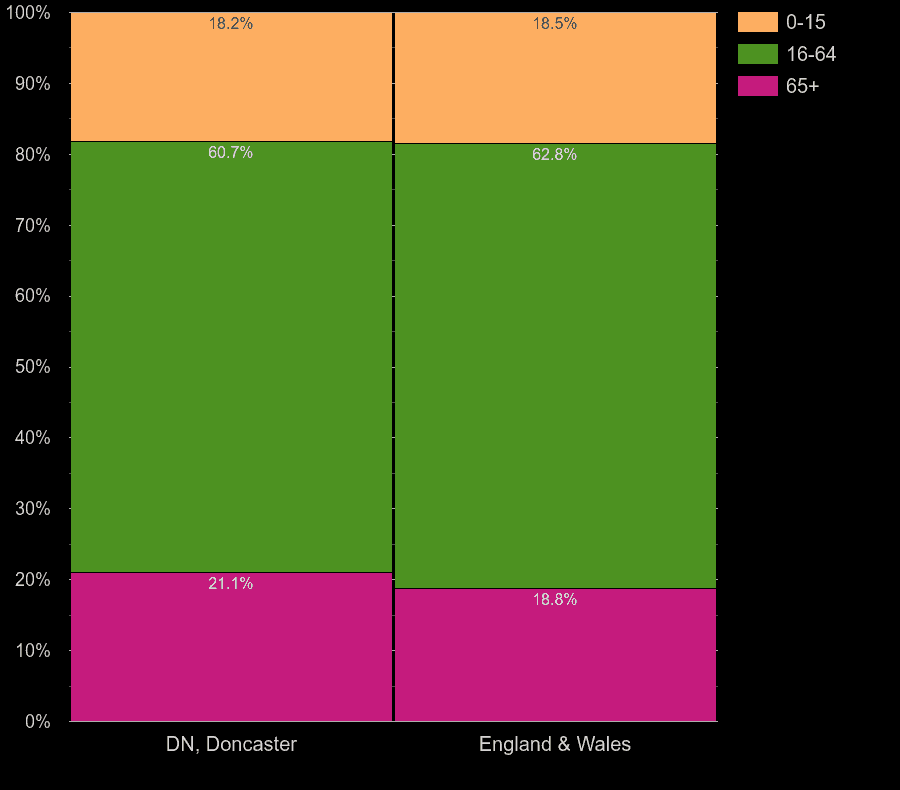
| age group | head-count | % share of population | % for Eng & Wales |
|---|---|---|---|
| 0-15 | 142k | 18.3% | 18.3% |
| 16-64 | 471k | 60.4% | 62.8% |
| 65+ | 166k | 21.3% | 18.9% |
Comparison of postcode areas average ages, 2024 population estimates.

| postcode area | Average age in 2024 |
|---|---|
| Doncaster | 42.4 |
| England & Wales | 40.8 |
Annual area statistics of Doncaster's population average age compared to country statistics.
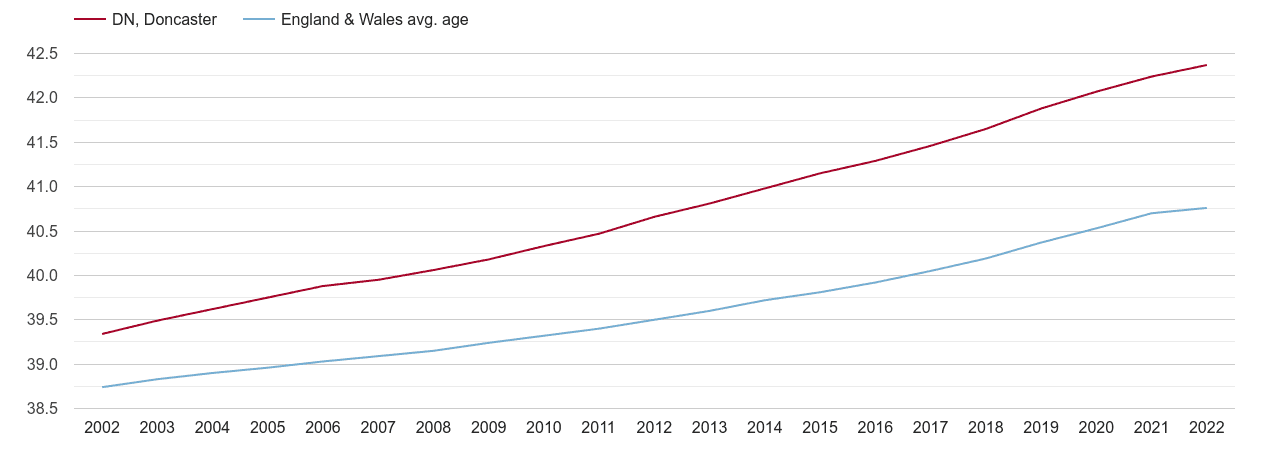
| Year | Doncaster postcode area | England and Wales |
|---|---|---|
| 2024 | 42.4 | 40.8 |
| 2023 | 42.3 | 40.7 |
| 2022 | 42.3 | 40.7 |
| 2021 | 42.2 | 40.7 |
| 2020 | 42.1 | 40.5 |
| 2019 | 41.9 | 40.4 |
| 2018 | 41.6 | 40.2 |
| 2017 | 41.5 | 40.1 |
| 2016 | 41.3 | 39.9 |
| 2015 | 41.2 | 39.8 |
| 2014 | 41.0 | 39.7 |
| 2013 | 40.8 | 39.6 |
| 2012 | 40.7 | 39.5 |
| 2011 | 40.5 | 39.4 |
| 2010 | 40.3 | 39.3 |
| 2009 | 40.2 | 39.2 |
| 2008 | 40.1 | 39.2 |
| 2007 | 40.0 | 39.1 |
| 2006 | 39.9 | 39.0 |
| 2005 | 39.8 | 39.0 |
| 2004 | 39.6 | 38.9 |
| 2003 | 39.5 | 38.8 |
| 2002 | 39.3 | 38.7 |
Purple-colored areas are business or industrial areas. Green-colored areas provide quieter surroundings and better living. Map is based on a UK Census 2011 data. Colors calculated from the ratio of number of residents divided by a number of workday people.

 login →